Crawl Space Encapsulation in Natick
Crawl space encapsulation in Natick, MA. Insurance billing accepted. Call (508) 756-8800.
Our technicians are dispatched from our Auburn, MA headquarters and are typically on-site in Natick within 60 minutes of your call.
Natick sits in a part of eastern Massachusetts where the ground holds moisture long after a storm passes. The town’s mix of glacially deposited soils — sandy in some pockets, heavy clay in others — means crawl spaces beneath older homes can stay damp for days after a wet spell, even when the surface looks dry. If you’ve noticed a musty smell rising through your floors, soft spots in hardwood, or condensation on the pipes under your house, the crawl space is almost always where the problem starts.
Why Natick Crawl Spaces Are Prone to Moisture Problems
Much of Natick’s residential housing stock dates to the post-war building boom of the 1940s through 1960s, with a meaningful share of homes going back even further. Those older foundations were built before vapor barriers were standard practice — many crawl spaces were left as bare earth with nothing between the soil and the floor framing above. Over decades, ground moisture migrates upward through that soil, saturating floor joists and insulation from below.
Natick’s climate compounds the issue. Winters bring freeze-thaw cycles that push groundwater and frost against foundation walls. Summers bring humid air that flows freely into an unencapsulated crawl space and condenses on cooler surfaces. The town also sits within the Sudbury River watershed, and properties near lower-lying areas can experience elevated water tables during snowmelt and spring rain events. A crawl space that feels dry in August may be collecting moisture by March.
Vented crawl spaces — the design standard for most of the twentieth century — actually make things worse in New England’s climate. The theory was that ventilation would dry the space out. In practice, warm humid summer air flows in, hits the cooler crawl space surfaces, and deposits moisture rather than removing it.
Our Crawl Space Encapsulation Process in Natick
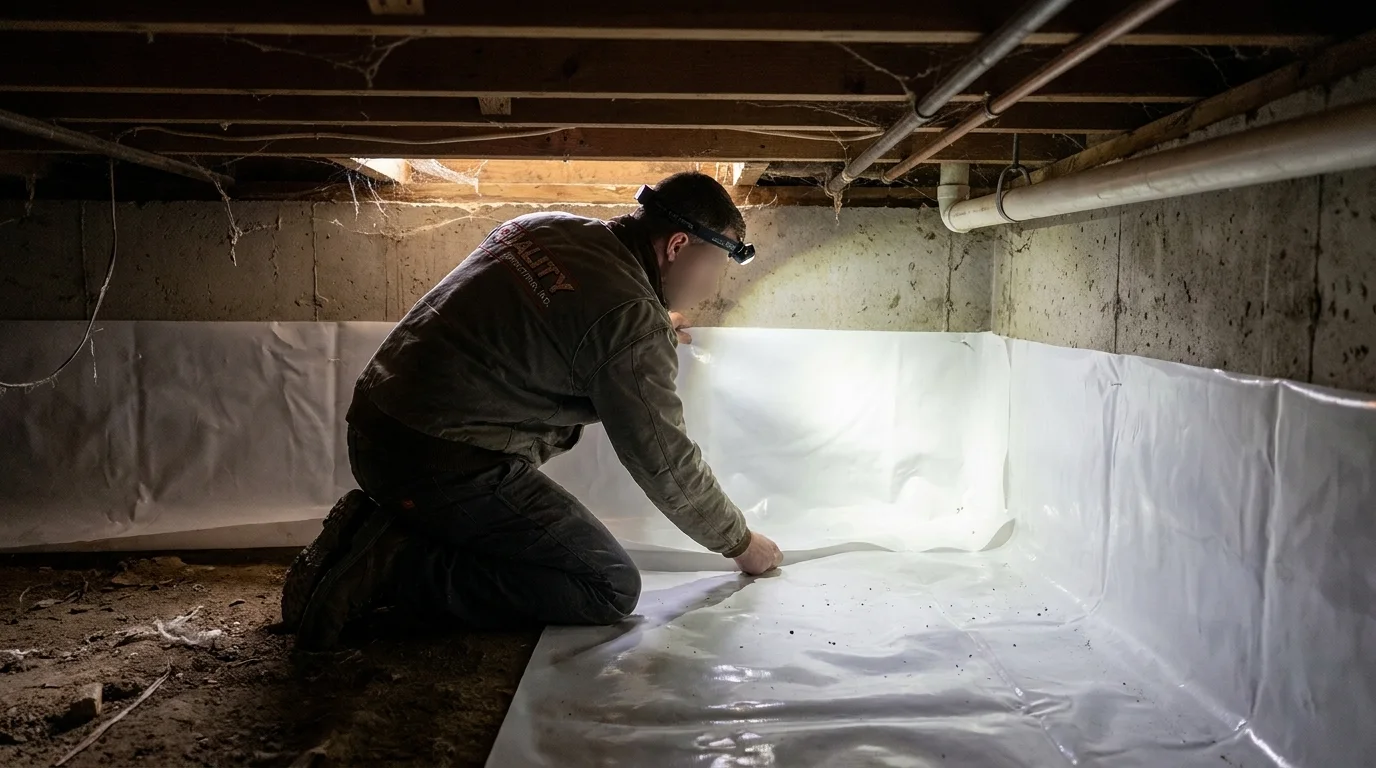
Encapsulation works by sealing the crawl space off from ground moisture and outside air entirely. The process is more involved than laying down a sheet of plastic — done correctly, it transforms a damp, problematic space into a controlled environment that protects your floor system and improves the air quality in the living space above.
The work begins with a thorough inspection of the existing conditions: standing water, deteriorated insulation, signs of wood rot or mold colonization on joists, and the condition of any existing vapor barrier. Any standing water is removed and the space is dried before encapsulation materials go in.
A heavy-duty polyethylene liner — typically 12 to 20 mil thickness — is installed across the entire floor and up the foundation walls, sealed at seams and at penetrations like pipes and support columns. Vents are sealed to prevent outside air infiltration. Depending on conditions, a dehumidifier sized for the space may be installed to maintain relative humidity at a level that discourages mold growth. In some Natick homes with older masonry foundations, we also address wall seepage points before the liner goes in, because encapsulation over an active water intrusion source only traps the problem.
Natick Building Considerations and Permits
In Massachusetts, crawl space work that involves sealing foundation vents can intersect with building code requirements, particularly around moisture control and energy code compliance. Natick’s building department issues permits for work that alters a home’s thermal envelope, which encapsulation can affect. It’s worth confirming permit requirements before work begins — the scope of the project and whether you’re adding mechanical dehumidification can affect whether a permit is required.
For homeowners in Natick who carry flood insurance through the National Flood Insurance Program, changes to a crawl space’s venting configuration can affect your policy’s technical compliance. If your property is in or near a mapped flood zone, it’s worth a call to your insurance agent before sealing foundation vents.
Local Note
Natick has a notable concentration of split-level and raised-ranch homes built in the 1950s and 1960s, a style that was popular across Middlesex County during that era. These homes often have partial crawl spaces adjacent to a finished lower level, with a shared wall between the two. Moisture that builds up in the crawl space side doesn’t stay there — it migrates through that partition wall and can cause mold growth inside finished walls that’s invisible until it’s well established. When we work on these homes, we pay particular attention to that transition zone, because standard encapsulation of just the crawl space floor won’t fully address the problem if the shared wall is allowing moisture transfer.
Quality Contracting, Inc. serves Natick from our Auburn location. To schedule an assessment of your crawl space, call us at (508) 756-8800.
Serving Natick from our Auburn headquarters — ★ 4.6 · 95 Google reviews
“I am so happy I chose this company to move our belongings to our new home. The whole process was seamless and the guys (Henry’s team) were incredible. They were kind, considerate, careful, and fast! I will tell everyone to use your company. I didn’t mention one of the best parts, your quote was…” — Heather, August 2026
Crawl Space Encapsulation in Natick: Service Coverage
Frequently Asked Questions
How fast can you arrive for crawl space encapsulation in Natick?
How does Natick's soil type affect whether my crawl space needs encapsulation?
My Natick home was built in the 1950s and still has the original vented crawl space. Is that a problem?
Does encapsulation work affect my Natick home's building permits or energy code compliance?
What thickness of vapor barrier liner is appropriate for a Natick crawl space?
How long does crawl space encapsulation typically take in a Natick home, and what disrupts the schedule?
Will my homeowners insurance cover crawl space encapsulation in Natick?
Crawl Space Encapsulation response in Natick
Most Natick calls see a technician on-site within 60 minutes from our Auburn headquarters.