Water Damage Restoration in Newton
Water damage restoration in Newton, MA. Insurance billing accepted. Call (508) 756-8800.
Our technicians are dispatched from our Auburn, MA headquarters and are typically on-site in Newton within 60 minutes of your call.
Newton’s housing stock tells the story the moment you walk a basement: fieldstone foundations from the 1890s, balloon-frame walls that run floor to rafters without fire stops, cast-iron drain stacks that have been patched more than once. When a pipe lets go or a nor’easter pushes water through a compromised sill, that history matters. Water doesn’t behave the same way in a 1910 Victorian as it does in new construction, and the drying plan has to account for it.
Why Newton Properties See Water Damage Differently
Much of Newton was built in the late 19th and early 20th centuries, when plaster-and-lath wall systems were standard. Unlike modern drywall, plaster is dense and slow to release moisture — a surface moisture reading can look acceptable within a day or two while the wooden lath behind it stays saturated for a week or more. That hidden saturation is where secondary mold colonization begins, typically within 48 to 72 hours of initial wetting.
Newton’s topography compounds the risk. The city sits across a series of rolling hills and low-lying corridors, and neighborhoods closer to the Charles River watershed — including Auburndale and Newton Lower Falls — can see groundwater intrusion during prolonged rain events that wouldn’t affect higher-elevation parts of town. Clay-heavy soils common throughout much of Middlesex County shed water rather than absorbing it, which means heavy rainfall has nowhere to go except toward foundations. Sump pump failures and window-well flooding are among the most common calls from Newton homeowners after a multi-day storm system.
Our Water Damage Restoration Process in Newton
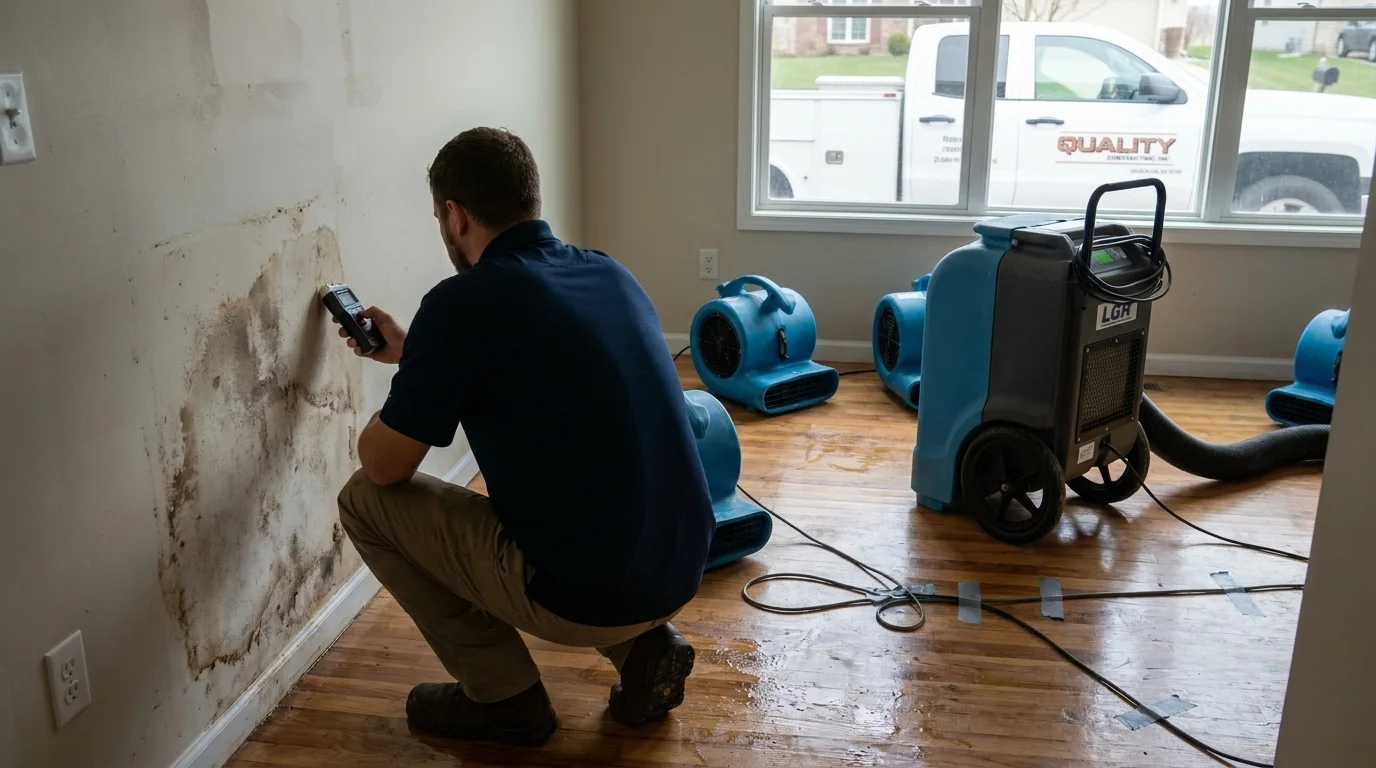
Every water damage job begins with a thorough assessment before any equipment is placed. Moisture meters and thermal imaging cameras map where water has traveled — not just where it’s visible. In Newton’s older homes, that often means tracing water movement through plaster ceilings from an upstairs bathroom, or finding saturation in a finished basement that entered through a crack in a parged fieldstone wall rather than through a floor drain.
Once the scope is documented, water removal begins. Standing water is extracted first using truck-mounted or portable extraction units, depending on access. Structural drying follows — commercial-grade desiccant or refrigerant dehumidifiers and high-velocity air movers are positioned to create a controlled drying environment. Drying logs are recorded daily so the process is defensible to your insurance adjuster and so we know precisely when materials have reached acceptable moisture levels rather than guessing.
Demolition is kept to the minimum necessary. In a home with original plaster, removing a wall to dry it faster isn’t always the right call — it depends on moisture readings, the extent of saturation, and what’s behind it. We make that call based on data, not convenience.
Reaching Newton from Auburn
Quality Contracting, Inc. is based in Auburn, which puts Newton roughly 30 to 40 minutes out via the Massachusetts Turnpike (I-90 East). The Pike connects directly into Newton’s western neighborhoods, making areas like West Newton and Newtonville straightforward to reach. For calls coming from the eastern side of the city — Chestnut Hill or Newton Centre — the route adds only a few minutes via Route 9.
If you’re scheduling service, calling (508) 756-8800 during business hours gets you to someone who can confirm timing and walk you through any immediate steps to limit damage before the crew arrives.
Newton Insurance Coordination
Newton homeowners are typically insured under standard HO-3 or HO-5 policies, and the documentation requirements for a water damage claim are specific: you need a written scope of loss, moisture mapping records, and itemized drying logs. We compile that documentation as part of the job — not as an afterthought. Photos are taken before, during, and after remediation, and the drying log is formatted to match what most major carriers expect to see.
If your policy includes a managed repair program, we can work within that framework. If you’re handling the claim independently, we’ll provide the documentation you need to submit it yourself.
Local Note
In Newton’s Auburndale and Newton Lower Falls neighborhoods, some homes were built with finished basement spaces that sit partially below the water table during wet seasons. Homeowners sometimes discover that a sump pump has been cycling constantly for years without anyone noticing — until it fails during a storm. In those situations, water extraction is only the first step; the more important conversation is about what drainage improvements or battery backup systems make sense before the next event. We’re not plumbers, but we flag what we see and can point you toward the right next call.
If water has reached your floors, walls, or ceiling in Newton, the window for preventing secondary damage is short. Call (508) 756-8800 to schedule an assessment and get a clear picture of what you’re dealing with before the moisture has time to migrate further.
Serving Newton from our Auburn headquarters — ★ 4.6 · 95 Google reviews
“I had a major main sewer line back up over the weekend that flooded out my finished cellar and had to get in touch with a hazmat company. I chose Quality Contracting. OMG what a lucky choice I made ! Everyone that I've dealt with from the company have been Wonderful. It all started with Amy in the…” — Gino, August 2026
Water Damage Restoration in Newton: Service Coverage
Frequently Asked Questions
How fast can you arrive for water damage restoration in Newton?
How quickly can Quality Contracting reach Newton from Auburn?
Do Newton's older plaster-and-lath homes take longer to dry than newer construction?
Are homes near the Charles River in Auburndale or Newton Lower Falls more prone to water intrusion?
What documentation will you provide for my Newton homeowner's insurance claim?
How do you decide whether to remove plaster walls or dry them in place in a Newton home?
Water Damage Restoration response in Newton
Most Newton calls see a technician on-site within 60 minutes from our Auburn headquarters.