Crawl Space Encapsulation in Wellesley
Crawl space encapsulation in Wellesley, MA. Insurance billing accepted. Call (508) 756-8800.
Our technicians are dispatched from our Auburn, MA headquarters and are typically on-site in Wellesley within 60 minutes of your call.
Wellesley sits on a landscape shaped by glacial till, shallow bedrock, and a network of ponds and wetlands that keep soil moisture levels elevated for much of the year. That combination means crawl spaces beneath Wellesley homes rarely get a chance to fully dry out on their own — and once humidity takes hold under a house, wood rot, pest activity, and air quality problems tend to follow quickly. Crawl space encapsulation addresses that cycle directly, sealing the space from ground moisture before it migrates into the living areas above.
Why Wellesley Properties Are Prone to Crawl Space Moisture
Much of Wellesley’s housing stock dates to the early and mid-twentieth century, when vented crawl spaces were the standard approach to foundation construction. The logic at the time was that outside air would carry moisture away. In a dry climate that might work. In eastern Massachusetts, where relative humidity regularly climbs above 70 percent through spring and summer, vented crawl spaces often do the opposite — they pull warm, humid outdoor air into a cool underground space, where it condenses on joists, insulation, and the subfloor above.
The town’s glacially deposited soils hold water well, and properties near the Charles River corridor or any of Wellesley’s several kettle ponds can experience elevated groundwater pressure after a heavy rain. Even homes on higher ground are not immune: clay-heavy subsoils slow drainage and keep moisture sitting near the foundation longer than it would in sandier terrain. A crawl space that looks dry in October can be dripping in April.
What Crawl Space Encapsulation Involves
Encapsulation is not simply laying plastic sheeting on the dirt floor. A properly executed job in a Wellesley home typically involves several coordinated steps:
Inspection and prep. Before any barrier goes down, the crawl space is inspected for standing water, existing mold or rot, pest evidence, and damaged insulation. Any of those conditions need to be addressed first — encapsulating over an active moisture problem traps it rather than solving it.
Debris and old insulation removal. Fiberglass batt insulation stapled between floor joists is common in pre-1980 construction. Once it has absorbed moisture, it loses its thermal value and can harbor mold. Removing it before sealing is standard practice.
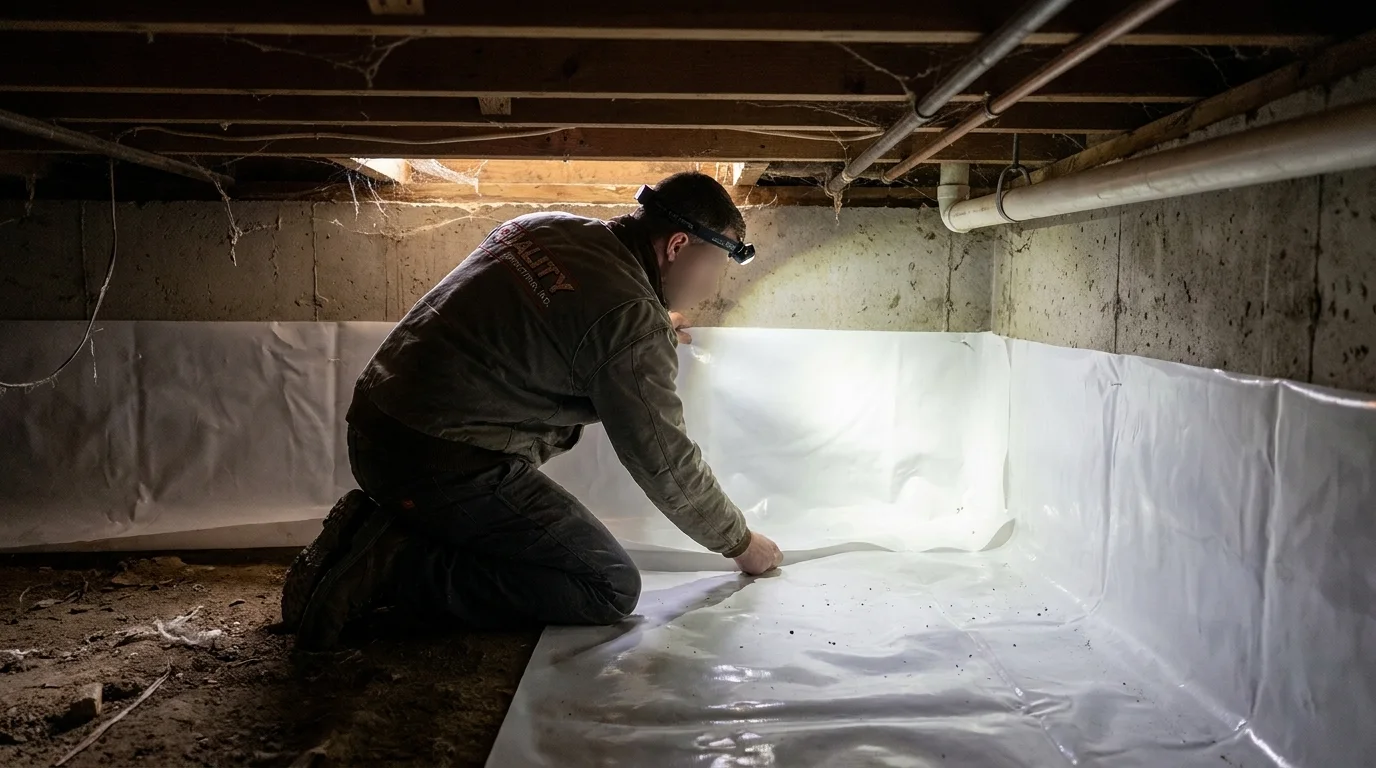
Ground barrier installation. A heavy-duty polyethylene liner — typically 12 to 20 mil — is laid across the crawl space floor and run up the foundation walls, sealed at the seams and at wall penetrations. This is the core of encapsulation: cutting off the primary moisture pathway from the soil.
Rim joist sealing. The rim joist area where the floor framing meets the foundation wall is a significant air and moisture infiltration point in older New England construction. Spray foam or rigid foam board is used to seal and insulate this zone.
Ventilation or dehumidification. Depending on the crawl space configuration, the space may be conditioned with a dedicated dehumidifier or brought into the home’s conditioned envelope by sealing foundation vents. Which approach is correct depends on the specific space — there is no one-size answer.
Doing This Work in Wellesley’s Older Homes
Homes built before World War II — and there are many in Wellesley — often have crawl spaces with low clearance, rubble stone foundations, and irregular geometry that makes installation more involved than in a newer home with a poured concrete perimeter. Stone foundations are porous and require careful detailing where the liner meets the wall. Low clearance means more hand work and longer labor time. These are not reasons to skip encapsulation; they are reasons to use a contractor who has worked in this type of construction before.
Wellesley also has a significant number of homes in established residential areas where landscaping, mature trees, and tight lot lines can affect crawl space access. Exterior access hatches are sometimes the only practical entry point, and the condition of those hatches matters for long-term performance of the encapsulation system.
Local Note
Homes near Wellesley’s pond-adjacent neighborhoods — particularly those on lower-lying lots close to the Charles River watershed — often show a specific pattern: the crawl space reads relatively dry through the summer, then moisture readings spike sharply in March and April as snowmelt and spring rain raise the local water table. Homeowners who inspect in August and conclude they don’t have a problem sometimes discover significant mold growth the following spring. If your home sits on a low lot or near any of Wellesley’s water features, a late-winter inspection before encapsulation is worth scheduling specifically to catch that seasonal peak.
If you’re ready to stop guessing what’s happening under your house, call Quality Contracting, Inc. at (508) 756-8800. The team works out of Auburn and serves Wellesley regularly — a straightforward drive west on Route 9 — and can assess your crawl space, explain what the conditions actually are, and give you a clear picture of what encapsulation would involve for your specific home.
Serving Wellesley from our Auburn headquarters — ★ 4.6 · 95 Google reviews
“I am so happy I chose this company to move our belongings to our new home. The whole process was seamless and the guys (Henry’s team) were incredible. They were kind, considerate, careful, and fast! I will tell everyone to use your company. I didn’t mention one of the best parts, your quote was…” — Heather, August 2026
Crawl Space Encapsulation in Wellesley: Service Coverage
Frequently Asked Questions
How fast can you arrive for crawl space encapsulation in Wellesley?
How does Wellesley's climate affect how long a crawl space encapsulation job takes?
Are older Wellesley homes with rubble stone foundations good candidates for encapsulation?
Does Wellesley have any permitting requirements for crawl space encapsulation work?
What is the difference between a vapor barrier and full encapsulation for a Wellesley crawl space?
How does Quality Contracting reach Wellesley from Auburn for a crawl space assessment?
Will my homeowners insurance cover crawl space encapsulation in Wellesley?
Crawl Space Encapsulation response in Wellesley
Most Wellesley calls see a technician on-site within 60 minutes from our Auburn headquarters.