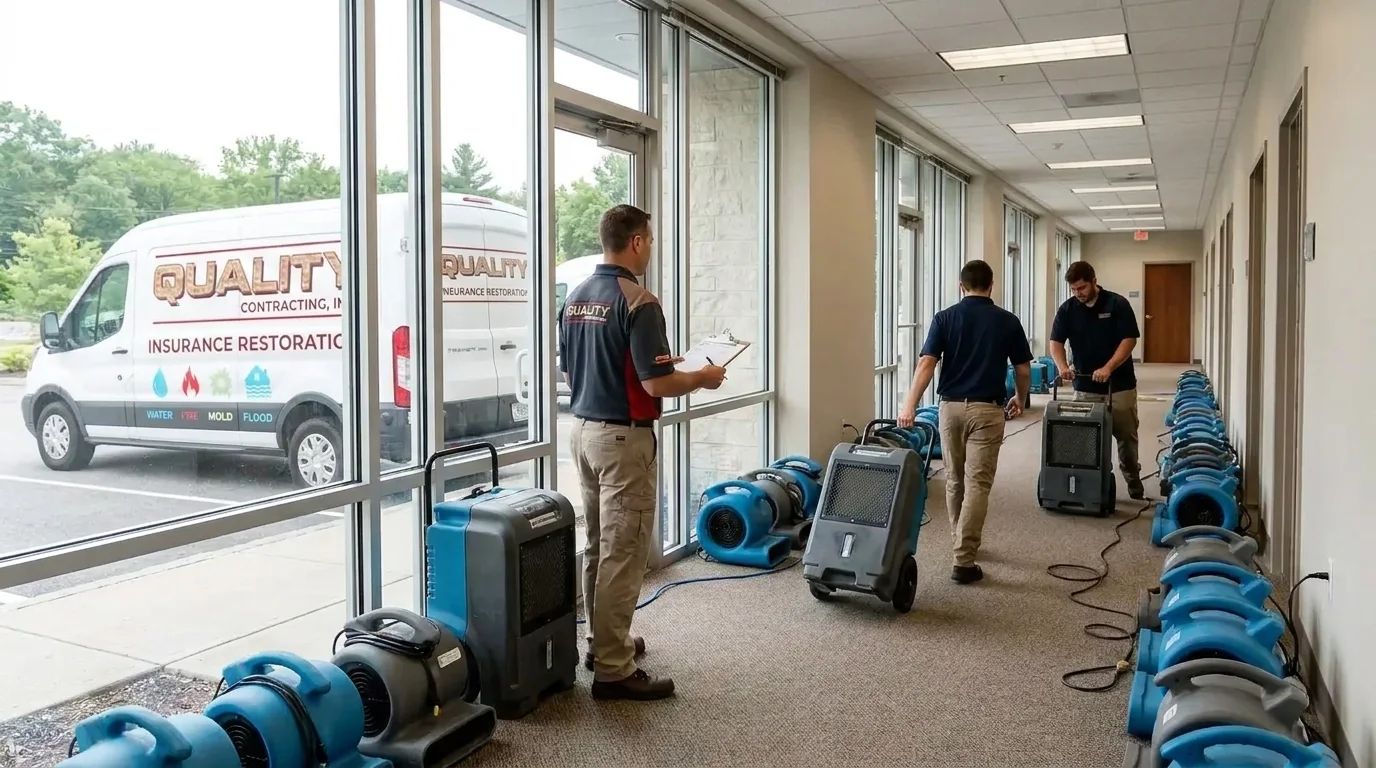
Large Loss and Catastrophic Response in Auburn
Large loss and catastrophic response in Auburn and surrounding areas. Insurance billing accepted. Call (508) 756-8800.
When a structure fire takes out three floors of a mill-building conversion, or a burst main floods forty units in a multi-family complex overnight, the damage stops being a single-crew job. Large loss and catastrophic response is what happens when a loss is big enough, or spread across enough square footage, that it needs a coordinated team working multiple zones at once, not a van and a dehumidifier. This is the work for property managers, commercial owners, and large-loss adjusters who need a contractor that can scale.
What large loss and catastrophic response actually involves
A large loss is defined less by the peril and more by its scope: multiple units or buildings affected, six or seven figures in projected damage, or a loss significant enough that the carrier assigns a large-loss adjuster or general adjuster instead of a standard desk adjuster. That could be a commercial roof failure that floods three floors of office space, a fire that spreads through shared attic space in a row of triple-deckers, or storm damage across an entire apartment complex. The work pulls in multiple crews simultaneously, often running water extraction in one wing while demo and board-up happen in another, with a project manager coordinating schedule, trades, and documentation across the whole site rather than one address at a time.
Our process
- Site assessment and stakeholder coordination. We walk the full scope with the property manager, owner, GC, and adjuster present where possible, and map the affected structures or units before any equipment moves in.
- Securing the property. Board-up, fencing, temporary power, and structural shoring go in first on any site where occupants, contents, or adjacent units are at risk.
- Parallel mitigation by zone. Extraction, demo, and drying run simultaneously across separately affected areas instead of sequentially, which is the main thing that separates a large-loss timeline from a standard one.
- Scope documentation for the carrier. Every zone gets its own photo record, moisture logs, and line-item scope so the large-loss adjuster can review and approve work in stages rather than waiting on a single final estimate.
- Reconstruction sequencing. Once mitigation clears, trades are scheduled in the order that lets occupied or partially occupied buildings come back online fastest, unit by unit or floor by floor.
What separates a good large loss response from a bad one
The most common failure on a catastrophic job is treating it like a big version of a small job: one crew, one schedule, one point of contact trying to cover a dozen units. That creates bottlenecks, and bottlenecks on a large loss mean carrying costs the owner didn’t budget for. A second common mistake is undocumented scope creep. On a loss this size, adjusters expect itemized, zone-by-zone documentation, not a lump estimate, and gaps in that paper trail are where claims stall or get disputed. A third is skipping engineering review on structural questions, moisture intrusion into load-bearing assemblies, fire damage to framing members, or snow-load related roof stress, which can turn into a much bigger problem once finishes go back on. Good large-loss response means a dedicated project manager, phased work that keeps unaffected units occupiable where safe, and documentation built for the adjuster from day one, not reconstructed afterward.
What does large loss and catastrophic response cost?
Costs on large-loss work vary enormously because the scope varies enormously, a flooded basement in one building and a multi-structure fire are both “large loss” but nowhere near the same number. Every loss gets a written scope of work before anything starts, because estimating a catastrophic job off a phone call isn’t realistic for anyone. Most commercial and multi-family policies cover large-loss mitigation and reconstruction under the same business or property policy that covers a smaller claim, though limits, sub-limits for things like ordinance and law upgrades, and business interruption coverage vary by policy.
| Scenario | Typical range |
|---|---|
| Multi-unit water loss, 10-20 units affected | $150,000 - $500,000 |
| Commercial fire, single structure | $300,000 - $1,500,000+ |
| Multi-building storm or wind damage | $500,000 - $3,000,000+ |
| Partial structural collapse or roof failure | $1,000,000+ |
| Large-loss reconstruction only (post-mitigation) | $250,000 - $2,000,000+ |
Seasonal & regional considerations
Worcester County’s winters bring the two conditions that most often turn a bad situation into a catastrophic one: heavy snow load on flat and low-slope commercial roofs, and sudden freeze-thaw cycles that split pipes in the older mill buildings and triple-deckers common throughout Auburn and the surrounding area. A pipe failure in an occupied multi-family building during a cold snap can affect a dozen units before anyone notices standing water above a finished ceiling. Spring thaw and Nor’easter season bring the storm-driven version of the same problem, roof and window failures across whole complexes rather than a single unit.
Service area
Quality Contracting, Inc. is based in Auburn and responds to large-loss and catastrophic jobs across Worcester County, including Worcester, Millbury, Oxford, Shrewsbury, and surrounding communities, wherever a property manager or carrier needs a contractor that can mobilize multiple crews on one site.
If you’re managing a loss that’s bigger than one crew can handle, get a project manager and a written scope in front of you fast. Call (508) 756-8800 to start your large-loss assessment.
Services We Handle
- Insurance Loss Repair
- Insurance Restoration
Frequently Asked Questions
Does homeowners or commercial insurance cover large loss and catastrophic restoration?
What actually qualifies a loss as \"large loss\" rather than a standard claim?
How do you coordinate multiple crews and trades across one catastrophic site?
How is scope documented for a large-loss adjuster compared to a standard claim?
What's a realistic timeline for a multi-million dollar restoration project?
Looking for the best large-loss-response company in Auburn?
Quality Contracting, Inc. provides large-loss-response in Auburn, MA and the surrounding area. Customers rate us 4.5 out of 5 stars across 110 Google reviews. We answer calls 24/7 — call (508) 756-8800 for immediate help.
Need large-loss-response now?
We respond 24/7 across Auburn and surrounding MA cities.
Related Coverage
- Our Restoration Services
- Contact Quality Contracting, Inc.
- Restoration Services in Bellingham
- Restoration Services in East Douglas
- Restoration Services in Fiskdale
- Restoration Services in Framingham
- Restoration Services in Franklin Town
- Restoration Services in Hopkinton
- Restoration Services in Hudson
- Restoration Services in Leominster
- Restoration Services in Marlborough
- Restoration Services in Maynard
- Restoration Services in Milford
- Restoration Services in Natick