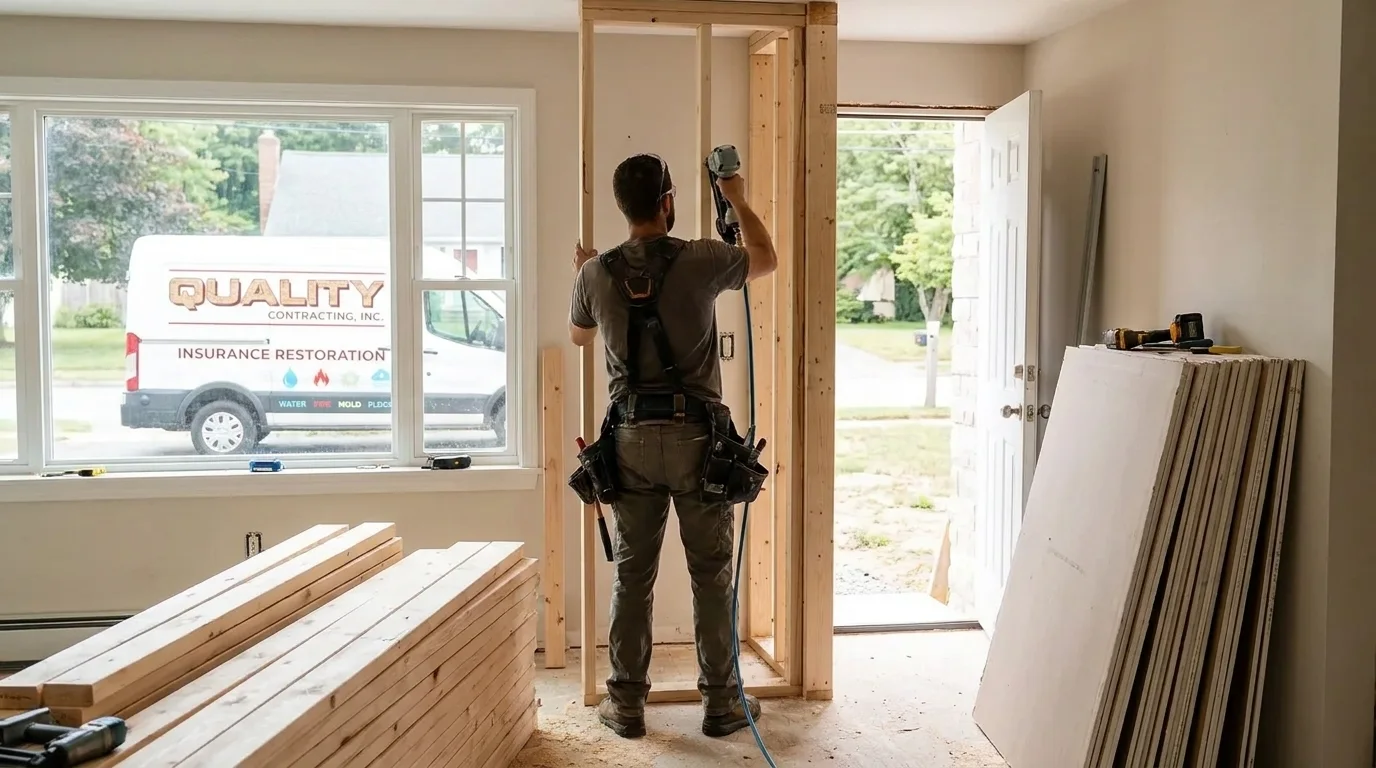
Reconstruction Services in Auburn
Reconstruction services in Auburn and surrounding areas. Insurance billing accepted. Call (508) 756-8800.
When a water, fire, or storm loss has been mitigated, the damaged materials are still gone: the cut drywall, the removed flooring, the charred framing, the section of roof that was tarped and torn off. Reconstruction services auburn is the rebuild phase that homeowners often don’t think about until they’re staring at open studs and a plastic sheet where a kitchen used to be. This is structural reconstruction and post-disaster rebuilding: turning a mitigated loss back into a finished, livable space, done to code and documented the way an insurance adjuster expects to see it.
What reconstruction services actually involves
Post-damage reconstruction covers everything from a single drywall and flooring repair to a full interior rebuild after a fire or major flood. It can mean replacing subfloor after prolonged water exposure, reframing a wall section that was removed for mold remediation, rebuilding a kitchen after a grease fire, or reconstructing a roof section after storm damage. The scope depends entirely on what was removed during mitigation and what the structure needs to pass inspection. Timelines range from a few days for a single room to several months for a whole-house fire rebuild, and the work typically touches framing, insulation, drywall, flooring, trim, paint, and sometimes electrical or plumbing rough-in if those systems were affected.
Our process
- Scope of work. We document what was removed during mitigation, what remains, and what needs to be rebuilt, then put it in writing, matching materials and finishes where possible so the repair doesn’t look patched.
- Permits and code review. Structural work, electrical, and plumbing changes typically require permitting through the local building department. We pull what’s required before framing starts, not after.
- Framing and rough-in. Studs, subfloor, and structural members go back in to match the original layout, or an improved one if code has changed since the structure was built. Electrical and plumbing rough-in happens before walls close.
- Finishing. Drywall, taping, texture, flooring, trim, and paint bring the space back to a livable condition. This is usually the longest phase and the one homeowners notice most.
- Final walkthrough. We review the finished work against the original scope and address punch-list items before calling the job complete.
What separates a good reconstruction response from a bad one
The most common mistake is closing up walls before an inspector or adjuster has seen the condition underneath. Framing that was never properly dried or treated after a water loss, or char that wasn’t fully removed after a fire, gets covered by new drywall and becomes a problem years later. A good reconstruction crew photographs every phase, keeps the paper trail an adjuster needs, and doesn’t frame over a structural member that still reads wet on a moisture meter.
Another gap shows up at the permit stage. Skipping permits on load-bearing work or electrical changes can stall a home sale later or void part of a warranty. Adjusters also look closely at whether the rebuild matches the pre-loss condition, not an upgraded version billed at the same rate, so an itemized scope of work matters as much for the insurance side as it does for the homeowner’s expectations.
What does reconstruction cost?
Costs vary widely because every reconstruction job starts from a different point: a single damaged wall is a different project than a gutted kitchen or a fire-damaged second floor. The ranges below reflect typical industry figures for post-damage rebuild work, not a quote. Every loss is different, which is why Quality Contracting, Inc. provides a written scope of work before any rebuild begins. Homeowners insurance typically covers reconstruction costs tied to a covered peril, such as a burst pipe or fire, though coverage details depend on the policy and the cause of loss.
| Scenario | Typical range |
|---|---|
| Single room drywall and flooring repair | $2,500 - $7,000 |
| Kitchen rebuild after fire or water damage | $15,000 - $45,000 |
| Bathroom reconstruction after a plumbing failure | $6,000 - $18,000 |
| Full interior rebuild, single floor | $40,000 - $120,000 |
| Structural framing repair (wall or roof section) | $5,000 - $20,000 |
| Whole-house fire damage reconstruction | $75,000 - $300,000+ |
Seasonal & regional considerations
In Auburn and the surrounding Worcester County towns, a lot of the housing stock dates to the early-to-mid 1900s, with balloon-frame construction and plaster-over-lath walls in the older neighborhoods. That construction type behaves differently during reconstruction than modern platform framing: wall cavities often run uninterrupted from basement to attic, which affects how fire and water damage spread before mitigation and how framing repairs need to be sequenced. New England winters also push most rebuild schedules toward exterior work in warmer months and interior finishing through the colder ones, since drywall and paint cure more predictably in heated, controlled conditions.
Service area
Quality Contracting, Inc. handles reconstruction work in Auburn and nearby communities including Worcester, Oxford, Charlton, Millbury, and Webster. Local permitting requirements vary by town, and we handle that coordination as part of the rebuild scope.
If mitigation is finished and you’re looking at open framing, missing drywall, or a rebuild that insurance needs documented correctly, get a reconstruction scope of work from Quality Contracting, Inc. at (508) 756-8800.
Frequently Asked Questions
Does homeowners insurance cover reconstruction after a fire or water loss?
Do I need a permit for reconstruction work after a fire or water damage?
How do you decide what gets reframed versus what can stay?
How long does a typical reconstruction project take?
Will the rebuilt space match what was there before the damage?
Looking for the best reconstruction company in Auburn?
Quality Contracting, Inc. provides reconstruction in Auburn, MA and the surrounding area. Customers rate us 4.5 out of 5 stars across 110 Google reviews. We answer calls 24/7 — call (508) 756-8800 for immediate help.
Need reconstruction now?
We respond 24/7 across Auburn and surrounding MA cities.
Related Coverage
- Our Restoration Services
- Contact Quality Contracting, Inc.
- Restoration Services in Bellingham
- Restoration Services in East Douglas
- Restoration Services in Fiskdale
- Restoration Services in Framingham
- Restoration Services in Franklin Town
- Restoration Services in Hopkinton
- Restoration Services in Hudson
- Restoration Services in Leominster
- Restoration Services in Marlborough
- Restoration Services in Maynard
- Restoration Services in Milford
- Restoration Services in Natick