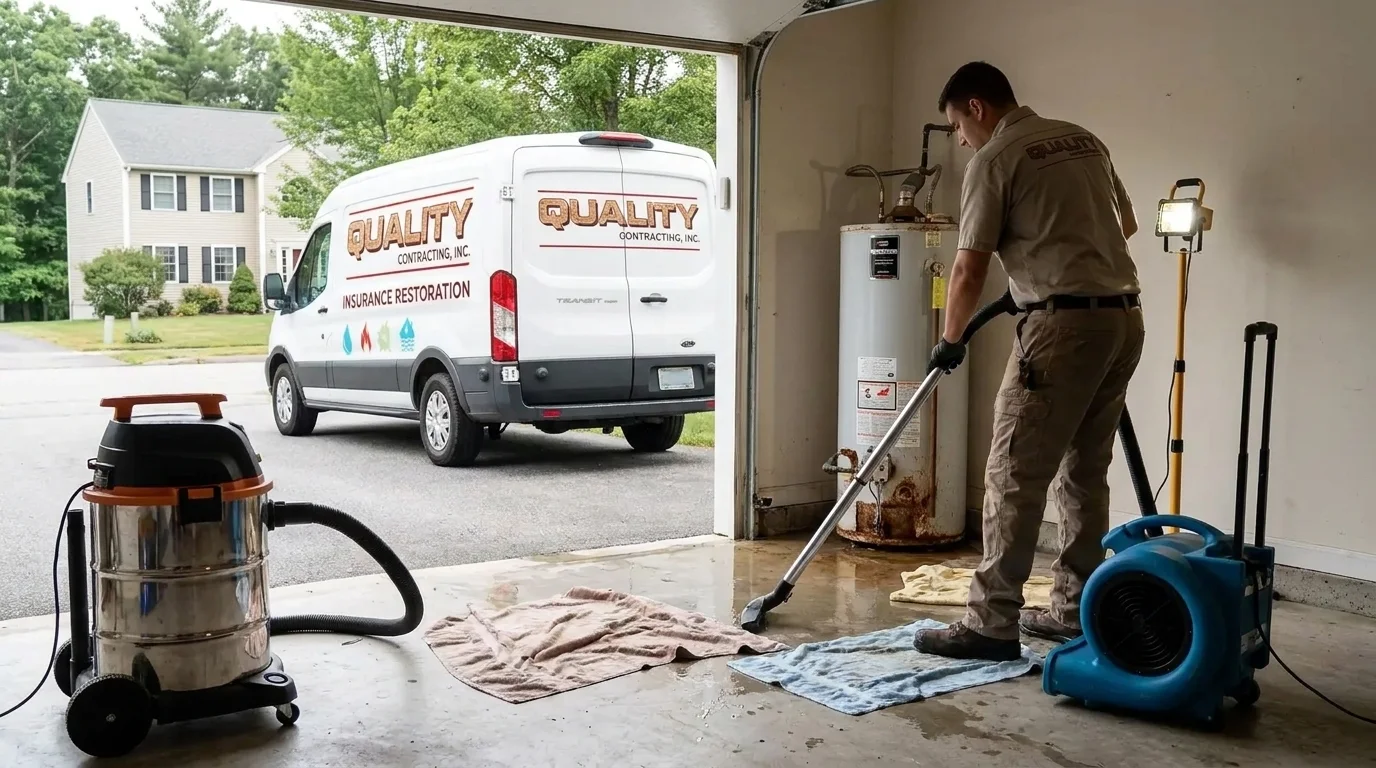
Emergency Water Heater Flood Cleanup in Auburn
Emergency water heater flood cleanup in Auburn and surrounding areas. Insurance billing accepted. Call (508) 756-8800.
Burst pipe or leak in Auburn? Call now for emergency service. Our crew responds fast to stop the water and start the cleanup.
Water heater flood cleanup in Auburn? Call now for prompt scheduling at (508) 756-8800. A failed tank or ruptured supply line can put thirty to eighty gallons of water into a utility closet, basement, or first-floor space in minutes, and if the unit sits on an upper level, that water finds every seam in the subfloor below before anyone notices.
What water heater flood cleanup actually involves
A leaking or burst water heater is a clean-water loss at the moment of failure, but it rarely stays that way. Tank corrosion, sediment, and rust particulate contaminate the water as it drains, and if it’s been sitting for more than a day or two, it starts tracking toward Category 2 territory. The work involves shutting off the water supply and gas or electric to the unit, extracting standing water from flooring and any pooled areas, pulling baseboards and sometimes lower drywall to check the wall cavity, and setting air movers and dehumidifiers to dry the subfloor, framing, and any insulation that got wet. If the tank was in a finished basement or a closet near living space, carpet pad, laminate flooring, and cabinet toe-kicks are common casualties that need to come out rather than dry in place.
Our process
- Source confirmation and shutoff. We verify the water heater is isolated (supply valve closed, power or gas off) before any extraction starts, since a slow leak that’s still active will undo drying work.
- Water extraction and material assessment. We remove standing water with truck-mount or portable extraction equipment and check flooring, baseboards, and drywall moisture content with a meter rather than guessing by sight or smell.
- Selective demolition where needed. Wet carpet pad, saturated laminate, and swollen baseboard typically come out; hardwood and tile often don’t, depending on how long the water sat and what’s underneath.
- Structural drying and monitoring. Air movers and dehumidifiers are placed based on the affected square footage, and we track moisture readings over several days until subfloor and framing are back to a dry standard, not just surface-dry.
- Documentation for the claim. Photos, moisture logs, and a written scope of the affected materials are compiled for the homeowner and the insurance carrier.
What separates a good water heater flood response from a bad one
The most common mistake is drying the visible surface and closing the job without checking what’s underneath. A subfloor under vinyl or laminate can read dry at the top while the plywood stays saturated for days, and that’s exactly where mold gets a foothold within 24 to 72 hours in a warm, enclosed utility space. Another frequent miss is ignoring the wall cavity behind baseboard, especially in a finished basement, where water wicks up drywall from the bottom and stays trapped behind insulation. Adjusters generally want to see moisture readings taken at multiple points, not a single reading, along with photos of the water heater itself (tank corrosion, fitting failure, or valve condition) since that often determines whether the loss is covered as sudden and accidental. A good response also checks for water that traveled to an adjacent room or down through a floor joist bay to the level below, which is easy to miss if the inspection stops at the utility closet door.
What does water heater flood cleanup cost?
Costs depend on how much water escaped before it was found, what flooring and wall materials got wet, and whether the water sat long enough to affect subfloor or framing. Every loss is different, which is why Quality Contracting, Inc. provides a written scope of work before any cleanup begins. Homeowners insurance typically covers sudden water heater failures as part of a standard policy, though coverage can vary if the failure is tied to long-term neglect or a known slow leak.
| Scenario | Typical range |
|---|---|
| Small area, caught quickly, no material removal | $500 - $1,200 |
| Utility closet or small basement area, some baseboard and pad removal | $1,200 - $2,800 |
| Finished basement, drywall and flooring removal, multi-day drying | $2,800 - $6,500 |
| Water traveled to a floor below, multiple rooms affected | $5,000 - $12,000+ |
| Subfloor replacement required after extended saturation | $3,000 - $7,000 (often in addition to drying costs) |
Seasonal & regional considerations
In Auburn and the surrounding Worcester County area, a lot of water heaters sit in basements with older cast-iron or copper plumbing, and tank failures tend to cluster in late fall and winter when the unit is working harder and incoming water is colder, which stresses aging tanks and fittings. Many of the area’s homes were built mid-century with basements that aren’t fully finished at the slab, so water can spread further and faster across bare concrete before it’s noticed, sometimes reaching a sump pit or floor drain on the opposite side of the room.
Service area
Quality Contracting, Inc. handles water heater flood cleanup in Auburn and nearby communities throughout Worcester County, including homes with the finished and unfinished basement layouts common to the area’s housing stock.
If a water heater has failed or is actively leaking, schedule your water heater flood cleanup assessment with Quality Contracting, Inc. at (508) 756-8800 before the water spreads further into subfloor or framing.
Frequently Asked Questions
Does homeowners insurance cover water heater flood damage?
How do I know if my water heater leak is a slow leak or a sudden failure?
Can I just dry the floor myself after a water heater leak?
What happens to the area under my water heater during cleanup?
How long does drying take after a water heater floods a basement?
Looking for the best water-heater-flood-cleanup company in Auburn?
Quality Contracting, Inc. provides water-heater-flood-cleanup in Auburn, MA and the surrounding area. Customers rate us 4.5 out of 5 stars across 110 Google reviews. We answer calls 24/7 — call (508) 756-8800 for immediate help.
Need water-heater-flood-cleanup now?
We respond 24/7 across Auburn and surrounding MA cities.
Related Coverage
- Our Restoration Services
- Contact Quality Contracting, Inc.
- Restoration Services in Bellingham
- Restoration Services in East Douglas
- Restoration Services in Fiskdale
- Restoration Services in Framingham
- Restoration Services in Franklin Town
- Restoration Services in Hopkinton
- Restoration Services in Hudson
- Restoration Services in Leominster
- Restoration Services in Marlborough
- Restoration Services in Maynard
- Restoration Services in Milford
- Restoration Services in Natick